Reading Tablature
or
How to (almost) Read Music Without Really Reading It
In college guitar classes, when it came to the time that I would introduce tablature, I got four students to volunteer to become temporary thespians. The cast included Mom, Johnny One Note, SuperMusician, and a narrator. Once I found four worthy volunteers (it wasn't difficult) I directed them to read the following mini-play that I had written. It was always a great way to introduce the subject of tablature. Just for fun, perhaps you could find three friends to join you and read it!
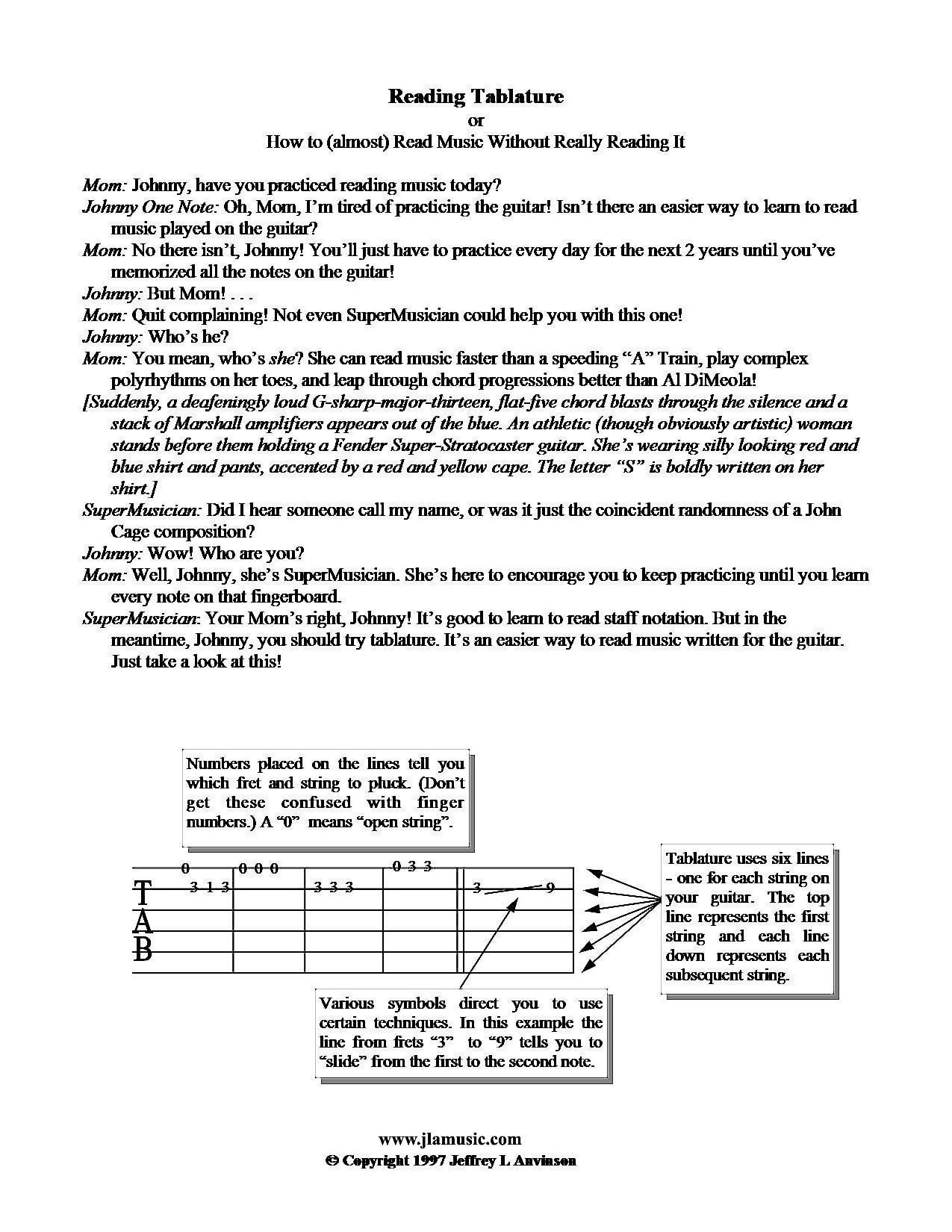
Below the mini-play is a simple example of basic tablature that will hopefully form a quick introduction to how tablature works for the guitar. Tablature is not the same as a music staff - the former has six lines while the latter has five. Each line represents one of the six strings on a guitar. Keep in mind that the top line of tablature represents the highest-pitched string, which is the string located closest to the floor. (It sounds the highest despite being located lowest physically. The lowest-sounding string is located highest. In other words, it's basically upside down! Is it any wonder why we guitar players are sometimes confused while reading music?!) ;-)
Tablature has been in existence for centuries in various forms. If you're interested, check out the seminal book by James Tyler: The Early Guitar: A History and Handbook. TIP: Find some early German tablature from centuries ago and try to read it - it will blow you away!
Jeff Anvinson, owner/operator of JLA Music